Edge AI vs embedded AI
Both terms describe AI inference running outside a cloud data centre. Both contrast with cloud AI. In many deployments, the same device qualifies as either. That is why the terms get used interchangeably — and for the layman, that is harmless. But for the engineer, the distinction is not semantic. It shapes which models you can run, which frameworks you can use, and whether your chosen AI model architecture fits the chip at all.
Capacity and capability.
Most AI lives in a data centre. A model trains on GPU clusters, runs on GPU servers, and returns results from remote servers. Typically the hardware is powerful and the latency is acceptable. That arrangement works well until you try to apply AI away from the desktop — to a physical AI, robotics, IoT devices, and behind a firewall. There, the data centre is not just costly. It is absent. Literal Labs builds AI for that reality. Logic-Based Networks (LBNs) run where the data is, not where the compute is comfortable.
The confusion between the two terms is understandable. Both describe AI running outside a cloud. In many deployments, the same hardware can run either. But the two terms carry different assumptions about processor capability, memory, power, and connectivity. Those assumptions lead engineers towards different AI algorithm choices and different deployment architectures.
The gap matters most where budgets are tight: battery budgets, energy budgets, connectivity budgets, and token budgets. Here, the decisions between edge and embedded AI matter the most.
Edge AI
AI inference running at or near the data source, rather than in a cloud. The "edge" is a network concept. It spans a wide hardware range — from capable industrial servers and AI gateways to microcontrollers embedded in sensors. Location relative to the data source defines it, not the hardware tier.
Embedded AI
AI running directly on embedded hardware: constrained, purpose-built systems integrated into a product. Limited RAM, no GPU, often no operating system. An embedded system is always at the edge, but an edge system is not always embedded. The constraint level is what separates them.
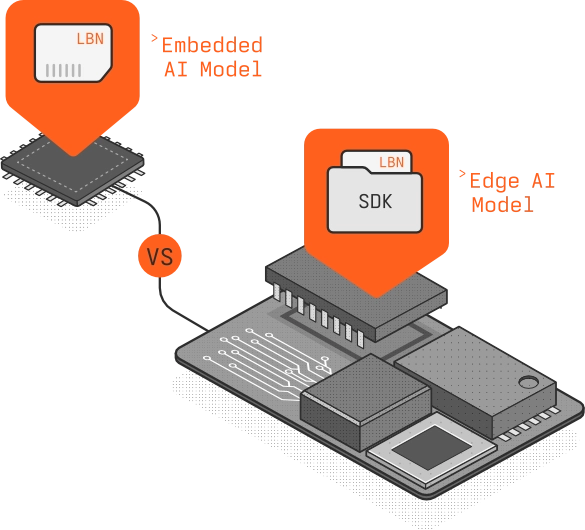
The dimensions of difference.
| Dimension | Edge AI | Embedded AI |
|---|---|---|
| Location | At or near the data source | Within the device itself |
| Hardware range | MCUs through to edge servers and AI gateways | MCUs and constrained SoCs; likely IoT |
| Operating system | Full OS possible (Linux, Windows IoT, Android) | Minimal or none (bare metal, RTOS) |
| Memory | Megabytes to gigabytes | Kilobytes to low megabytes |
| Power constraints | Moderate to tight | Tight to severe |
| Connectivity | Often available | Often absent or intermittent |
| Floating-point support | Usually available | Often absent on lower-end MCUs |
| Battery powered | Possible | Possible |
| Examples | Edge server, AI gateway, smart camera, industrial PC | Microcontroller, integrated sensor, ECU, BMS |
Where the distinction means a decision.
Choosing between edge and embedded AI is rarely just a terminology question. It is an engineering decision with consequences for hardware cost, model architecture, and how the system behaves when connectivity fails. Three areas force the choice into the open.

Hardware selection
Edge AI can run at the point of inference or close to it, on hardware capable enough to support a full operating system. That opens the door to standard ML frameworks, richer runtime environments, and a wider model design space than most embedded deployments permit. Embedded AI targets hardware integrated directly into the asset: constrained MCUs with kilobytes of memory, no OS, and a power budget measured in microwatts. The hardware determines everything downstream. Get it wrong and no amount of model optimisation recovers the situation.

Model design
Edge hardware with a capable processor and meaningful memory can run quantised neural networks, 1-bit and low-bit architectures, and tree-based models. The design question is accuracy and latency within a manageable space. On constrained embedded hardware, the question is more fundamental: which model class fits at all. Neural networks, even aggressively compressed, frequently exceed available SRAM or offer poor accuracy. LBNs are designed for this constraint from the outset. The algorithm choice is not a preference. It is determined by the hardware.

Connectivity and autonomy
Edge AI systems are nearly always connected. A network link enables centralised monitoring, periodic model updates, and event reporting. Embedded AI systems make no such assumption. Remote sensors, underground infrastructure, and vehicle ECUs may have no network access during normal operation. The model runs, makes a decision, and transmits only that decision when connectivity allows — not the raw data behind it. Autonomy is often the point. It reduces bandwidth, preserves privacy, and keeps the system functional when the network is not.
Built for the full spectrum.
From the most constrained MCU-based IoT deployments through to capable edge hardware, Logic-Based Networks are suited to the full range of AI model deployments. The same architecture scales across the spectrum.

No GPU or NPU required
LBN inference runs on any standard 32-bit processor, from a Cortex-M0 sensor node where GPU silicon is not economically viable to a capable edge server where GPU hardware adds cost without adding value to the inference task. The model runs on whatever processor is already there.

Compact C-code SDK
The same SDK integrates into bare-metal firmware and Linux-based embedded environments. No runtime dependencies. No framework overhead. No dynamic memory allocation. The firmware team includes a header, calls two functions, and the model runs on first boot.

Deterministic inference
The same input always produces the same output. Essential for embedded safety-critical applications where stochastic variation is unacceptable, and equally important for certification under IEC 61508, ISO 26262, or similar standards. Determinism substantially simplifies validation and audit.

Energy-efficient AI inference
Energy efficiency matters across the spectrum: from coin-cell-powered remote sensors where it determines whether the product is viable at all, to always-on edge servers where it directly affects operating cost. LBN inference draws substantially less energy per prediction than neural network approaches at every hardware tier.

Train AI for edge or embedded.
Whether training edge or embedded AI models, ModelMill provides end-to-end capabilities: from data labelling and model training to deployment on the target hardware. ModelMill is designed for the full spectrum of AI inference, from constrained embedded devices to capable edge servers and beyond.