UC01 · Predictive Maintenance AI · 2026
Predictive maintenance AI that runs at the edge.
Logic-Based Networks are built for forecasting and prediction. Trained on your sensor data, they detect failure before it happens, at the point of measurement, on the microcontroller already embedded in the asset. No cloud round-trip. No GPU. No connectivity dependency. Just reliable performance, at low cost, keeping your most critical assets online.
Unplanned downtime costs trillions a year.
Machinery fails. Motors. Pumps. Compressors. Conveyors. The list runs through almost every industry that makes or moves something. Failure costs American industrial manufacturers around US$50 billion a year. Unplanned. Across the Fortune Global 500, the broader toll is some $1.5 trillion annually, equivalent to 11% of total revenues.
Those figures are compounded by how maintenance is done today. Assets are run until they break. Or maintained to a calendar schedule, regardless of condition, by teams that were monitoring all along and still missed the signal.
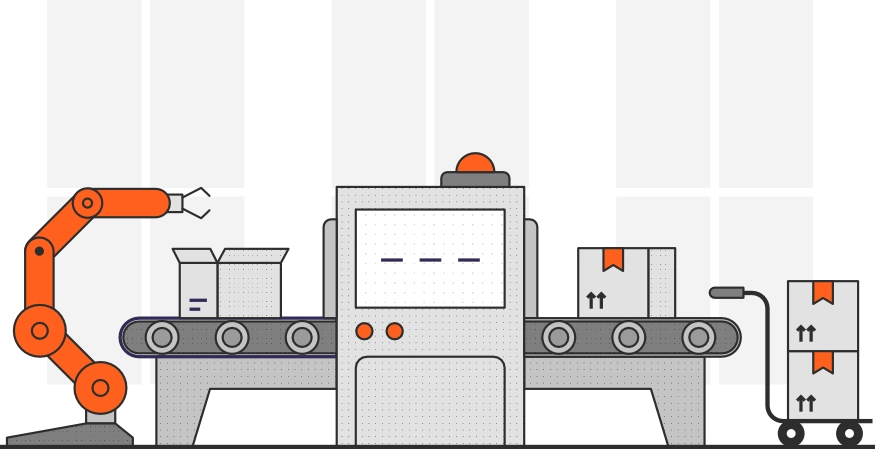

Run-to-failure — No intervention until the asset stops. Maximum asset utilisation, maximum repair cost, and maximum disruption when the failure lands at the worst possible moment.

Schedule-based maintenance — Maintenance carried out at fixed intervals, whether the asset needs it or not. Often over-maintains healthy equipment whilst missing developing faults that fall between service dates.

Condition-based monitoring — Better than a calendar, but dependent on thresholds and human review. A sensor can be logging anomalies for weeks before anyone acts on them.
Prediction, not just reaction.
The alternative is predictive maintenance. It targets the 42% of unplanned downtime caused directly by equipment failure, and reduces the cost of unplanned maintenance interventions by up to 35% per event.
With AI-driven predictive maintenance, the case is well established.
reduction in maintenance costs
Siemens — True Cost of Downtime 2024
reduction in inventory levels
Deloitte — Predictive Maintenance 2024
reduction in downtime
McKinsey Industrial AI Report 2025
The predictive solution is logical.
Predictive maintenance typically comes at significant cost. The GPU-backed inference platforms and cloud streaming pipelines that most PdM solutions require introduce infrastructure overhead that makes deployment at scale prohibitive.
Logic-Based Networks (LBNs) replace floating-point matrix multiplication — the core computation of neural networks — with propositional logic: AND, OR, and NOT operations evaluated on binarised sensor inputs. These are the elementary operations of digital logic. Any processor that handles 32-bit integers can execute them, without a floating-point unit, without specialist silicon, and without meaningful power overhead.
On an Arm Cortex-M4 — a chip available for under $5 and already present in millions of industrial sensors — the MLPerf Tiny benchmark result is unambiguous. The LBN model for the standard anomaly detection task occupies 7.29 KiB of flash. Most industrial MCUs carry 32 KB to 512 KB of flash total. A 7 KB model fits. A multi-megabyte neural network, even after aggressive quantisation, does not.


Fast enough, or useless
Some faults move fast. A bearing in a high-speed spindle. A pump serving a process that cannot be interrupted. The window between detectable and damaging can be seconds. Cloud round-trips take longer. By the time the inference comes back, the decision has already been made for you.

Works where the network does not
Industrial environments are not server rooms. Subsea installations, remote pipelines, underground plant, and factory floors with dense RF interference all have one thing in common: connectivity is intermittent at best and absent at worst. An AI model that needs a network to run goes quiet precisely when and where continuous monitoring matters most.

The chip is already in the machine
Most industrial assets already carry an embedded microcontroller. It sits in the sensor assembly, the motor drive, or the control card. Already powered. Already connected to the signal. Predictive maintenance AI that demands a separate compute platform, a dedicated gateway, or a GPU-backed server is not a maintenance solution — it is a new infrastructure project. Those are two very different proposals to sign off.

Explainable by design
Logic-Based Networks produce decisions from auditable logical rules. Not statistical weights that approximate a result, but human-readable conditions that can be inspected, challenged, and documented. For safety-critical and regulated applications, that is not a nice-to-have.
faster inference
On an Arm Cortex-M4 at the MLPerf Tiny anomaly detection benchmark, LBN inference runs 54× faster than the best neural network result on the same hardware.
less energy per inference
On the same MLPerf Tiny benchmark, LBN inference consumes 52× less energy per inference than a neural network on identical hardware — the difference between years and months on battery-powered assets.
KiB model footprint
The LBN anomaly detection model occupies 7.29 KiB of flash. Typical industrial MCUs carry 32 KB to 512 KB total. The model fits alongside firmware, RTOS, and communication stack without hardware changes.
By design
Same input, same output. LBN inference is deterministic and the logical rules driving each result can be read and audited — inherently interpretable for safety-critical and regulated applications.
Data in. Decisions out.
ModelMill is the end-to-end platform for training, deploying, and optimising predictive maintenance Logic-Based Networks. The workflow is built for engineering and maintenance teams — not machine learning specialists. Labelled sensor recordings go in; a complete C-code deployment package comes out. No AI experience required.
Key features
- Agentic AI data annotation
- Customisable UI for performance benchmarking
- Team-based labs for collaborative projects
Key benefits
- Models trained specifically to your assets and business case
- Built-in automation — no prior AI experience required
- Inference runs locally; no data sent to the cloud
- Model performance is continuously monitored and updated
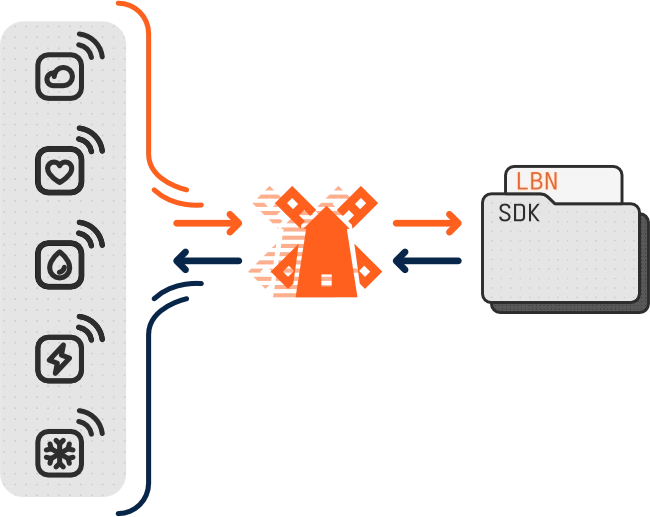
Gather labelled sensor recordings under normal operating conditions and during or after fault events. Event-level labelling ("normal," "bearing fault," "cavitation") is sufficient; sample-level annotation is not required.
Upload your data to ModelMill. The platform ingests vibration, acoustic, current, or multi-sensor recordings, constructs the training pipeline, and trains a population of LBN candidates against your labelled data.
ModelMill surfaces accuracy, inference latency, energy consumption, and model size for each candidate — benchmarked against the hardware profile you specify. Select the model that fits your deployment constraints.
The selected model is packaged as a self-contained C SDK containing the trained LBN, inference engine, build configuration, and documentation. No ML framework dependencies. No runtime overhead.
Integrate the SDK into your existing embedded firmware. The model runs on the sensor MCU alongside existing code. No cloud dependency. No ongoing inference cost. No network required at inference time.
Every fault type. Every sensor modality.
Predictive maintenance covers a wide range of fault types and monitoring approaches. LBNs have been applied across all of the principal industrial sensor modalities — and handle multi-sensor fusion natively, without changes to the integration pattern.

Vibration
For motors, pumps, compressors, gearboxes, and spindles. Detects bearing wear and imbalance.

Acoustic
For pumps, valves, fans, and compressed-air systems. Detects seal failure and flow anomalies.

Motor current
For electric drives and conveyors. Detects winding faults and bearing degradation via current draw.

Ultrasonic leak
For pipelines, pressure vessels, and pneumatic systems. Detects leaks before pressure loss registers.

Temperature
For motors, transformers, and process plant. Detects overheating that precedes insulation or bearing failure.

Humidity & moisture
For enclosures, switchgear, and stored goods. Detects ingress that causes corrosion and insulation breakdown.

Pressure
For hydraulic systems, pipelines, and pumps. Detects developing blockages, leaks, and cavitation.

Multi-sensor fusion
For complex assets with overlapping fault signatures. Combines modalities for higher classification accuracy.

Liquid quality & viscosity
For lubrication systems, process fluids, and food and beverage lines. Detects contamination and degradation.

Torque & load
For drive shafts, couplings, and gearboxes. Detects overload, misalignment, and mechanical wear.

Insulation resistance
For motors, transformers, and cables. Detects insulation breakdown before winding failure or arc events.

Thermal imaging
For switchgear, PCBs, and refractory linings. Detects hot spots invisible to contact sensors.

Flow rate
For pipelines, HVAC, and process plant. Detects blockages, pump degradation, and valve wear.

Voltage
For power distribution, UPS systems, and battery-backed plant. Detects supply instability and ripple faults.

Gas & emissions
For oil and gas, chemical plant, and confined spaces. Detects leaks and combustion anomalies at source.

Structural strain
For bridges, pressure vessels, wind turbines, and rail. Detects cumulative stress before crack propagation.

Speed & RPM
For turbines, fans, and rotating drives. Detects slip, resonance, and speed instability under load.

Corrosion & coating
For pipelines, offshore structures, and storage tanks. Detects wall thinning before structural integrity is compromised.

Battery state of health
For EVs, UPS systems, and industrial battery banks. Detects capacity fade and cell imbalance before failure.
Sixty days. Your data. Your assets. Your model.
The Literal Labs 60-day PdM Pilot Programme takes your existing sensor data to develop a validated, ready-to-deploy predictive maintenance model — built to your assets, tuned to your failure modes, and tested against your own benchmark.
- Fixed 60-day execution timeline with defined milestones
- Time to Value typical within 6 months of deployment
- Limited spaces available
We align to your business targets and review your sample data.
We develop a predictive maintenance AI model based on your data and defined success criteria.
Performance comparisons produced against common or your own baselines.
Joint review of results and agreement on next steps — field trial or deployment.
Where failure is not an option.
Predictive maintenance AI with LBNs applies across every sector where rotating or mechanical equipment operates under continuous or high-utilisation conditions — particularly where connectivity is unreliable, power budgets are tight, or data must not leave the asset.
Manufacturing
CNC machining centres, conveyor systems, press machinery, and production line drives. Detection of tooling wear, spindle bearing degradation, and motor winding faults — directly on the machine controller, without additional hardware or cloud dependency.
Oil and gas
Compressors, pumps, and rotating equipment at upstream, midstream, and downstream facilities. On-device inference in ATEX and hazardous area environments where wireless transmission of raw process data is restricted.
Energy and utilities
Water treatment pumps, HVAC plant, wind turbine drivetrains, and transformer monitoring. Extended deployment on battery-powered or energy-harvesting sensor nodes, where 52× lower power consumption is a hard operational requirement.
Automotive
Robotic welding and assembly equipment, stamping press maintenance, engine test bench monitoring, and fleet vehicle health detection. High-throughput production environments with zero tolerance for unplanned stoppages.
Rail and transit
Bogie bearing monitoring, traction motor health, HVAC systems, and trackside infrastructure. AI running on existing embedded controllers in rolling stock — no additional hardware, no connectivity required during operation.
Aerospace and defence
Gearbox and actuator health monitoring in air-gapped environments where cloud connectivity is structurally prohibited. Deterministic, auditable inference that meets the interpretability requirements of safety-critical certification programmes.
Frequently asked questions
What is predictive maintenance AI? 
Predictive maintenance AI uses machine learning models to detect early signs of equipment failure from sensor data — vibration, acoustic, current, or temperature — before failure occurs. Unlike scheduled or reactive maintenance, AI-based predictive maintenance identifies the specific asset and fault type, enabling targeted intervention at the right time.
Can predictive maintenance AI run without cloud connectivity?
Yes. Logic-Based Networks deploy as C code running on the microcontrollers already embedded in industrial sensors and controllers. Inference runs entirely on-device — no network connection, no cloud round-trip, no data transmission required at inference time.
How accurate are LBNs for fault detection?
In MLPerf Tiny benchmarks, LBNs achieve anomaly detection accuracy within 2% of comparable neural network baselines, whilst running 54× faster and consuming 52× less energy on identical hardware. For most industrial applications, this accuracy level is entirely appropriate given the substantial operational advantages.
What sensor data does predictive maintenance AI use?
LBNs have been applied successfully to vibration data from accelerometers, acoustic data from microphones and ultrasonic sensors, motor current waveforms, and combinations of multiple sensor types. ModelMill supports any structured or time-series input; the training workflow handles the preprocessing.
How long does it take to train and deploy a predictive maintenance model?
Training on ModelMill is automated. A typical run, from data upload to SDK delivery, completes in hours. Firmware integration of the SDK is typically measured in days. The critical input is training data: models perform best when trained on labelled examples of both normal operation and the fault classes to be detected.
Does predictive maintenance AI require additional hardware on existing equipment?
Not necessarily. Most industrial equipment already carries an embedded microcontroller. An LBN trained for the relevant fault types can run on the existing MCU alongside current firmware. Where the existing hardware is insufficient, the model footprint and power requirements are small enough that adding a low-cost MCU is rarely a significant project cost.