Battery-powered AI
For battery-operated IoT sensors, the energy cost of each inference determines whether a product is commercially viable. A field sensor that runs for three months before battery replacement needs servicing four times a year. One that runs for ten years on the same battery changes the economics of the entire deployment. Energy per inference is not a footnote in the specification. It is the specification.
Why AI drains IoT batteries in months.
The power budget of a battery-operated IoT node is not generous. A CR2032 coin cell — the kind in a key fob or a wearable — stores approximately 2.5 watt-hours of energy. A standard AA battery stores around 3 watt-hours. These are the physical upper bounds for a device designed to be small, low-cost, and field-deployable without mains access.
Against this budget, three energy consumers compete: the radio (for transmitting data), the sensor and its acquisition electronics, and inference. Of the three, inference is the one that varies most dramatically depending on the AI model type.
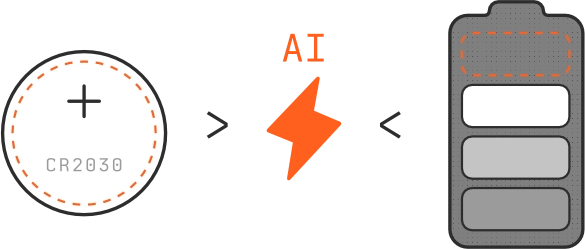
Neural network inference is computationally expensive by design. The dominant operation — floating-point matrix multiplication — requires significant processor cycles. On a microcontroller without hardware floating-point support, this computation is emulated in software: even slower and proportionally more energy-intensive. On a Cortex-M4 with a hardware FPU, floating-point multiplication is faster, but still requires sustained processor activity across dozens to hundreds of layers per inference.
A neural network running inference every five seconds on a battery sensor might draw an average of several milliwatts during the inference window. Over time, at 12 inferences per minute, this draws down the battery in weeks to months. The inference frequency that makes monitoring meaningful — high enough to catch anomalies before they become failures — is precisely the frequency that kills battery life.
The industry response to this problem has been quantisation: reducing weight precision from 32-bit float to 8-bit integer. This reduces memory and accelerates inference on hardware with INT8 support. It does not eliminate the energy problem; it shrinks it. The fundamental character of the computation remains floating-point-derived arithmetic requiring sustained processor activity. Battery life improves. It rarely improves enough to change the servicing economics of a large remote sensor deployment.
For deployments where battery replacement is a significant operational cost — remote infrastructure, agricultural sensors, structural monitoring — months of battery life is not sufficient. The acceptable answer is years. That requires a different class of inference computation, not a better-optimised version of the existing class.
Logic-Based Networks close this gap. The inference computation is propositional logic — AND, OR, and NOT operations applied to binary inputs. There are no floating-point multiplications, no multiply-accumulate chains across network layers. Bitwise logic is among the cheapest computation in digital electronics. The energy per operation is orders of magnitude lower than floating-point arithmetic, and the total operation count per inference is substantially smaller.
Logic replaces arithmetic — and the battery notices.
The 455 microjoule per inference figure is not a theoretical estimate. It comes from the wastewater network deployment described in the next section: an LBN running anomaly detection on a sewer sensor, making a prediction every five seconds, on hardware powered by a lithium battery. That is not a laboratory benchmark. It is a measured operating figure from a field deployment.
To put 455 µJ in context: a standard AA battery stores approximately 9,000 joules. At 455 µJ per inference, running every five seconds around the clock, the sensor makes roughly 20,000 predictions per day. The battery supports 90 million inferences before it is depleted — over twelve years of continuous operation at that rate. Coin-cell equivalent power reduces this window somewhat, but the order of magnitude is what matters: years, not months.

Architectural, not approximate
The energy gap between LBN and neural network inference reflects the difference between bitwise logical operations and floating-point matrix multiplication. One is among the cheapest computations in digital electronics. The other is among the most expensive on constrained embedded hardware. This is not a result of compression or approximation on the neural network side. It is an architectural difference in what the inference computation actually is.

Measured in a field deployment
455 µJ is the validated operating figure from the wastewater network sensor deployment. A standard AA battery stores approximately 9,000 joules of energy. At 455 µJ per inference every five seconds, a single battery supports more than 90 million predictions — over a decade of continuous operation. The figure includes all inference overhead: data loading, computation, and result output.

Serviceable for the asset lifetime
Many infrastructure sensors are installed in locations that are difficult or impossible to service frequently: underground chambers, embedded structural elements, remote agricultural land. A monitoring system with a ten-year battery life operates for the working life of the asset it monitors, or close to it. The maintenance cost model changes from scheduled battery replacement to essentially none.
UK wastewater network: 100,000 sites, no mains power.
The case for battery-powered AI at infrastructure scale is not theoretical. A UK water utility managing a network of 100,000 sewer monitoring sites needed continuous anomaly detection at each location — detecting blockages, overflows, and structural failures before they caused service disruption. The challenge was not technical; it was economic.
The problem
Detect anomalies across a geographically dispersed network of sewer sites continuously, at high frequency, before problems cause surface flooding or infrastructure damage. The monitoring system needed to be self-contained at each node: no assumption of reliable connectivity, no dependency on upstream infrastructure responding in real time.
The constraint
Power infrastructure at remote sewer sites costs approximately £15,000 per installation — trenching, cable, distribution equipment, and commissioning. At 100,000 sites, this amounts to £1.5 billion of power infrastructure spend before any sensor or software cost is considered. The Long Short-Term Memory neural network that performed the monitoring task accurately required this infrastructure. The business case did not close.
Sensors on battery power running the LSTM model lasted approximately three months before replacement was needed. At 100,000 sites, quarterly battery replacement is an enormous field service operation. The economics of that model are worse than mains power installation in many respects.
The result
An LBN anomaly detection model consuming 455 µJ per inference, running every five seconds, on a lithium battery. Projected battery life: ten years. No mains infrastructure. No quarterly maintenance visits. The sensor that the network already used became the full monitoring system, with intelligence running locally on its existing processor.
Field trials are underway. The commercial implication at scale — £1.5 billion of power infrastructure not purchased, battery replacement at decade intervals rather than quarterly — changes the project economics from infeasible to straightforward.
The full cost breakdown, including per-site and fleet-level numbers, is covered in the total cost of AI deployment analysis.
Where battery-powered AI changes what is possible.
The categories below share a structural property: they require AI inference in locations where mains power is unavailable, impractical, or uneconomical, and where the sensor must operate unattended for extended periods. For each, the design question is not whether to deploy intelligence, but whether the energy budget of the inference model allows the deployment to be commercially viable at all.

Environmental sensing
Air quality, water quality, and soil sensors at locations without power infrastructure — remote nature reserves, agricultural land, distributed water monitoring points. A monitoring node that operates for years without maintenance creates a categorically different monitoring network from one that requires quarterly visits. The density of sensor coverage that becomes economical at a ten-year service interval is far higher than at three months.

Structural health monitoring
Bridges, tunnels, pipelines, and buildings instrumented with vibration and strain sensors. Many installation points are inaccessible for routine service once the structure is in use. Sensors embedded in a concrete structure, attached to a bridge cable, or installed in an underground pipe chamber cannot be serviced frequently without significant disruption. A decade-long battery life is the practical minimum for a structural monitoring system to be worth installing.

Agriculture and precision farming
Soil moisture, microclimate, and crop health sensors across large areas of agricultural land. Power infrastructure is rarely available in field locations. Cellular connectivity may be intermittent and expensive at the volumes required for dense sensor coverage. A sensor that classifies locally and transmits summary events uses less radio energy than one that streams raw data — compounding the battery life advantage of low-energy inference with reduced transmission overhead.
The arithmetic of field life.
Designing a battery-powered sensor for a target field life requires accounting for the energy consumed by every active component. Inference is one component; radio transmission, sensor acquisition, and processor sleep modes are others. For IoT products where inference is a routine part of the operating cycle, the inference energy draw determines whether the overall budget closes.
The radio is often the dominant energy consumer in a connected IoT node. Transmitting a packet over LoRaWAN or NB-IoT requires millijoules per transmission — one to two orders of magnitude more than an LBN inference. This creates an important design implication: reducing the frequency of radio transmissions by classifying locally has a battery life impact that compounds with the energy reduction in inference itself. A sensor that previously streamed raw readings at one-minute intervals and now transmits classified events only when something meaningful occurs may save ten times more energy from reduced radio use than from reduced inference energy alone.
The interaction between inference and transmission energy is a key design variable. On-device inference enables event-driven transmission: the radio activates only when there is something worth reporting. For monitoring applications where anomalies are rare relative to normal operation, this can extend battery life dramatically.
The inference interval also matters. A sensor inferring every second uses twelve times the inference energy of one inferring every twelve seconds, at the same energy per inference. Designing an appropriate inference rate requires understanding the rate of change in the monitored signal and the time horizon within which detection matters. For predictive maintenance on slowly degrading machinery, an inference every thirty seconds may be sufficient. For detecting fast transient events in a control system, sub-second inference is necessary.
LBN inference at 455 µJ allows a frequency of one prediction per second on a single AA battery for more than 2,500 hours — over three months of continuous one-second inference without any other power draw. With an appropriate inference interval matched to the monitoring requirement, and event-driven radio use, multi-year field life is achievable on standard battery chemistry without specialised power electronics.
The AI for IoT section covers how on-device inference changes IoT network architecture more broadly. The total cost section addresses the fleet-level economics, including the field service costs that battery life directly determines.

Train AI models for battery IoT
ModelMill trains Logic-Based Network models with hardware constraints as first-class optimisation targets. Energy per inference is configured explicitly — the platform optimises simultaneously for accuracy, latency, and energy budget.