CPU vs GPU for AI inference
For edge and embedded AI, CPUs outperform GPUs across cost, power consumption, latency, and deployment simplicity. The caveat is real: this holds only when the model is designed for CPU-native execution. Run a GPU-native neural network on a CPU and the comparison reverses. The decisive variable is not the hardware. It is the algorithm.
AI beyond the GPU.
The conventional view is familiar: neural networks need GPUs, GPUs are faster than CPUs for matrix arithmetic, therefore GPU is the correct hardware for AI. This is true for the workloads it was derived from — large-scale model training, data-centre inference on large language models, batch processing of images in research pipelines. For those tasks, the comparison is not close.
The problem is that this view has propagated into contexts where it does not apply. Edge AI inference is not a data-centre workload. A motor bearing sensor making one classification decision per second on a microcontroller is not a language model serving ten thousand requests per minute. The hardware architecture that makes sense for one has little relevance to the other.
The GPU vs CPU comparison shapes purchasing decisions, product architectures, and deployment cost structures — often in the GPU direction when a CPU (or a much simpler MCU) would be not only adequate but superior. It is worth examining carefully what each processor type actually does well, and why.
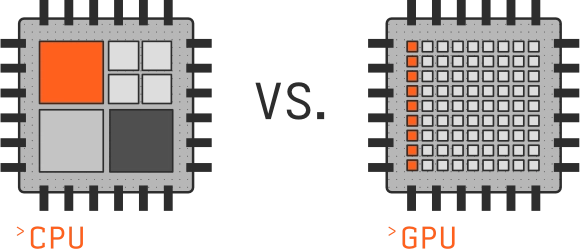
CPU vs GPU for AI inference: key differences.
| Factor | CPU | GPU |
|---|---|---|
| Latency (single-sample edge inference) | Low — deterministic, minimal overhead | Variable — transfer and bus overhead significant for small batches |
| Throughput (large batch) | Moderate | Very high |
| Energy consumption | Low to moderate | High |
| Unit cost | Low | High |
| Deployment complexity | Low | High — driver stack, runtime, cooling |
| Hardware availability (embedded/industrial) | Universal | Limited |
| Suitable model types | Logic-based, tree-based, quantised NNs | Large NNs, transformers, LLMs |
| Battery-powered deployment | Viable | Effectively no |
| Runs on existing embedded hardware | Yes | Requires dedicated silicon |
The table above reflects inference, not training. Training a neural network is an entirely different computational problem from running inference on a trained model. GPU dominance in training is well-established and not in dispute here. The question is inference — specifically, inference at the edge, on embedded hardware, for classification problems with real-time constraints.
Where GPUs are better.
GPUs are purpose-built for the parallel floating-point arithmetic that large neural network inference requires. Their thousands of small cores execute matrix multiplication with massive parallelism — the dominant operation in transformers, convolutional networks, and generative models.
Large-model inference
Serving a large language model, a diffusion model, or a foundation model requires batching many simultaneous requests and processing enormous weight matrices. The throughput that GPUs deliver at this workload is not replicated by any CPU configuration at comparable cost. Cloud AI and data-centre inference at this scale is genuinely a GPU problem.
High-throughput computer vision
High-throughput computer vision. Processing thousands of image frames per second — in large-scale surveillance systems, autonomous vehicle training pipelines, or industrial inspection at speed — requires the GPU's combination of memory bandwidth and parallel compute. The maths of convolution across high-resolution images fits the GPU execution model well.
Model training
Model training. Training a large neural network requires gradient computation across billions of parameters, applied iteratively over millions of batches. The compute intensity of this process makes GPU the standard across all frameworks. This is not contested. The relevant question is whether inference at the edge is the same kind of problem. It is not.
Where CPUs can win.
CPU inference becomes the right architecture under the following conditions. Each represents a real constraint. Each is common in embedded and industrial AI deployments.
Embedded and battery-powered devices
GPUs require watts. Embedded systems operate on milliwatt budgets. There is no practical path to GPU inference on a microcontroller or a battery-operated sensor. GPU silicon cost economics rarely close for mass-market IoT devices, and even where cost were acceptable, the power draw would make the product non-functional. On-device CPU inference is the only architecture that works.
Single-sample latency
GPUs deliver high throughput when processing large batches of inputs simultaneously. For single-sample inference — one sensor reading, one CAN bus message, one audio frame — batch size is one. The overhead of transferring a single input to GPU memory, processing it, and returning the result can exceed the end-to-end inference time on a well-optimised CPU implementation. For real-time classification of individual sensor events, CPUs often win on latency even when GPUs win on throughput.
Cost-sensitive volume products
Even low-cost GPU or NPU modules add material bill-of-materials cost. At scale — millions of IoT nodes, vehicles, industrial sensors — that additional cost per unit compounds to a significant programme cost. CPU inference runs on hardware already specified for the application. The AI capability is not a hardware cost; it is a software cost. For products competing on thin hardware margins, this distinction is commercially significant.
Deterministic and safety-critical requirements
Industrial control systems, automotive safety functions, and medical device applications require deterministic computation: the same input must produce the same output within a bounded time window, every time. GPU scheduling introduces variability that is difficult to bound and even harder to certify. CPU execution is deterministic and schedulable. For any application subject to IEC 61508, ISO 26262, or similar functional safety standards, CPU inference is substantially simpler to certify.
Brownfield hardware deployments
The majority of deployed microcontrollers, PLCs, and industrial embedded processors have no GPU and no NPU. Requiring GPU inference excludes the entire existing hardware base and the capital cost of replacing it. For adding AI capability to deployed infrastructure — a manufacturing line, a utility network, a vehicle fleet — CPU inference on existing hardware is the only architecture that does not require a hardware replacement programme.
CPU vs GPU: another frame.
The productive question is not which processor wins. It is which model architecture fits the processor you have. The CPU vs GPU comparison assumes neural networks throughout. When that assumption changes, the comparison changes with it.
Neural networks were designed for GPU hardware. Their core operation — dense floating-point matrix multiplication — maps naturally onto GPU parallel execution. Running the same neural network on a CPU means running a GPU-native operation on hardware designed for sequential computation. Performance falls. The conventional response is to add GPU or NPU silicon. This works but is expensive, power-hungry, and sometimes physically impossible for the target hardware class.
Logic-Based Networks (LBNs) use AND, OR, and NOT operations on binary inputs. These are native to every digital processor without exception. A CPU executes propositional logic efficiently because that is what digital logic gates do — compute logic natively. There is no mismatch. The model is designed for the hardware, not compressed to fit it.
The result is that an LBN on a standard CPU outperforms a neural network on equivalent CPU hardware by a substantial margin — not because the CPU became faster, but because the model's computational requirements match what the hardware does cheaply. See AI without a GPU for the architectural detail.
LBN vs neural network on CPU.
MLPerf Tiny provides standardised inference benchmarks for embedded hardware. The figures below are validated results from Literal Labs submissions on real embedded processors, plus field deployment measurements from production applications.
| Metric | Neural network (baseline) | LBN | Improvement |
|---|---|---|---|
| Inference latency | Baseline | 54× faster | 54× |
| Energy per inference | Baseline | 52× less | 52× |
| Latency on NXP PowerPC e200 (automotive MCU) | — | 4 microseconds per inference, on hardware from approximately 2006. No hardware modification required. | — |
| Semiconductor fault classification | — | 0.7ms latency, 2.6µJ per inference, on a standard industrial MCU CPU | — |
| FPU required | Yes (or significant slowdown) | No | — |
| Deterministic output | No | Yes | — |
The automotive figure is notable beyond the latency number. The NXP PowerPC e200 is not current hardware; it is a processor that has been in automotive embedded systems for approximately two decades. The LBN inference speed on this platform is sufficient for the target application. The alternative — a neural network on the same processor — was not. The customer's system integrator's solution also failed. The point is not simply that LBNs are fast. It is that they are fast enough on hardware that is already deployed, already qualified, and already paid for.
For the full cost implications of avoiding new silicon qualification, see the total cost of AI deployment analysis.
A decision framework.
The CPU vs GPU question resolves cleanly once the application requirements are specific. The following conditions define when each architecture is appropriate.
Choose GPU when:
The task involves large neural network inference on batched inputs: language model serving, large-scale image processing, generative model inference. The deployment is in a data centre or cloud environment with access to GPU infrastructure. Power consumption is not a binding constraint. Per-inference cost at data-centre scale is acceptable. Training any neural network of meaningful size.
Choose CPU (or MCU) when:
The deployment is on embedded or battery-powered hardware. The application requires single-sample inference at low latency. Power budget is constrained by battery, energy harvesting, or thermal limits. The hardware is already deployed and GPU silicon cannot be added without a hardware redesign. The application requires deterministic inference for safety or regulatory reasons. Cost per unit at volume makes GPU or NPU silicon impractical.
For edge and embedded inference — which describes the vast majority of industrial IoT, automotive embedded, infrastructure monitoring, and connected sensor applications — the CPU is not a compromise position. It is the correct architecture, provided the model running on it was designed for CPU execution rather than adapted from a GPU-native neural network. See the ModelMill platform for how LBN training produces models validated for the target CPU hardware from the outset.